Visitor Insurance · Data Index
Visitor Insurance Coverage & Limits Index 2026: 8 Plans, 4 Carriers, Age Band by Age Band
DigiCare Insurance read the plan pages and certificates of insurance for eight US visitor insurance plans across four carrier programs, then wrote down every published policy maximum, deductible rung and age cap. Coverage collapses with age. Patriot America Platinum sells up to $8,000,000 through age 64 and $20,000 at 80. Patriot America Plus tops out at $10,000 for an 80-year-old. No premiums appear here, only limits.
By the DigiCare Insurance editorial teamLast updated August 2, 2026
How we source and review answers$8M to $20K
Patriot America Platinum policy maximum, age 64 versus age 80
IMG certificate of insurance, form PPLAI (PPLGA) 04.29.26, read 2 August 2026
$10,000
Most an 80-year-old can buy on Patriot America Plus
IMG certificate of insurance, form PATAP (PGTAP) 04.29.26, read 2 August 2026
$100,000
Federal J-1 minimum per accident or illness (22 CFR 62.14)
22 CFR 62.14(b)(1), eCFR, read 2 August 2026
$36,400
Median helicopter air ambulance charge, GAO 2017 data
HHS ASPE issue brief HP-2021-20, citing a GAO report, 2017 data
What is a visitor insurance coverage limit?
A coverage limit is the most a visitor insurance plan will pay. The policy maximum is the ceiling across the whole coverage period. Sub-limits are smaller ceilings on named benefits like evacuation, dental or lost baggage. The deductible is what you pay first, before the plan pays anything. All three numbers change what you actually collect.
Those three numbers work in sequence. You pay the deductible. The plan then pays its share under the coinsurance split. Every payment counts against the policy maximum, and any benefit carrying its own sub-limit stops at that smaller figure no matter how much room is left above it.
Check one thing before you line up quotes: two carriers publish their ceiling on different bases. WorldTrips lists both an overall maximum limit and a maximum per injury or illness for the Atlas plans. IMG's certificates use a single figure it calls the "Period of Coverage limit". A $100,000 per-injury basis and a $100,000 overall basis are not the same product, and no competitor page we reviewed explains the difference.
The National Association of Insurance Commissioners describes travel medical insurance as "secondary health and accident insurance in case of illness or injury while traveling as most standard health insurance plans and Medicare likely will not provide coverage abroad", per the NAIC's travel insurance topic page. NAIC is writing about Americans going overseas. For an inbound visitor the mirror image applies: a home-country plan will usually pay nothing here.
How much coverage do you actually need?
There is no single right number, but there are hard cost anchors. HealthCare.gov puts a broken leg at up to $7,500 and an average three-day hospital stay at around $30,000. A federal analysis of 2017 charge data puts the median helicopter ambulance transport at $36,400. Against those figures, a $50,000 policy maximum is thin, not generous.
What US care actually costs
| Cost anchor | Published figure | Source and data year |
|---|---|---|
| Average emergency department visit | $530 | AHRQ HCUP Statistical Brief #268, 2017 cost data |
| Emergency department visit, patients 65 and over | $690 | Same brief, 2017 cost data |
| Emergency department visit, patients 17 and under | $290 | Same brief, 2017 cost data |
| Median rotary-wing (helicopter) air ambulance charge | $36,400 | GAO 2017 data, published by HHS ASPE in 2021 |
| Median fixed-wing (airplane) air ambulance charge | $40,600 | GAO 2017 data, published by HHS ASPE in 2021 |
| Fixing a broken leg | up to $7,500 | HealthCare.gov, undated |
| Average three-day hospital stay | around $30,000 | HealthCare.gov, undated |
| Comprehensive cancer care | hundreds of thousands of dollars | HealthCare.gov, undated |
Sources: AHRQ HCUP Statistical Brief #268 · HHS ASPE air ambulance issue brief, 2021 · HealthCare.gov
AHRQ's HCUP Statistical Brief #268, hosted on the NIH Bookshelf, is where the emergency department figures come from. It reports costs rather than charges, and it breaks results out by payer as well as age: $420 for Medicaid patients, $560 for privately insured patients and $660 for Medicare patients. The underlying data year is 2017.
The air ambulance figures come from HHS ASPE issue brief HP-2021-20, "Air Ambulance Use and Surprise Billing", published on 10 September 2021, which cites a Government Accountability Office finding on 2017 charges. The same brief reports that more than half of air ambulance transports for privately insured patients were out of network in its own 2016 claims analysis, and cites a separate GAO figure of 69% using 2017 claims data. Treat all of these as 2017 data published in 2021, not as current pricing.
For the hospital and cancer numbers we used HealthCare.gov's page on protection from high medical costs, which carries no visible publication date for them. We read that page on 2 August 2026.
One more thing shapes the arithmetic. Under the Emergency Medical Treatment and Labor Act, described by CMS, Medicare-participating hospitals that offer emergency services must screen and stabilize anyone who arrives, "regardless of an individual's ability to pay". That is an obligation to treat, not coverage. The bill still arrives afterward, and it arrives in full.
Source: CMS, Emergency Medical Treatment and Labor Act
What this means: a single helicopter transport at the published median would exhaust a $25,000 policy maximum and leave roughly $11,000 unpaid, before a doctor has seen the patient. Buyers comparing a $50,000 ceiling against a $500,000 ceiling are not choosing between good and better. They are choosing whether one bad night is survivable financially. These are estimates only, drawn from 2017 data, and real bills vary by hospital, state and network status.
Policy maximums and deductibles, all 8 plans
This is the full matrix. Every figure is a limit, meaning the most the plan will pay. None of them is a price.
| Plan | Carrier program | Underwriter | Deductible rungs | Policy maximum ladder |
|---|---|---|---|---|
| Atlas America | Offered by WorldTrips | Not asserted here | $0, $100, $250, $500, $1,000, $2,500, $5,000 (7) | $50,000 to $2,000,000 |
| Atlas America Premium | Offered by WorldTrips | Not asserted here | $0, $100, $250, $500, $1,000, $2,500, $5,000 (7) | $50,000 to $2,000,000 through age 64 |
| Patriot America Plus | IMG | SiriusPoint Specialty Insurance Corporation, administered by IMG | $0, $100, $250, $500, $1,000, $2,500 (6) | $50,000 to $1,000,000 through age 69 |
| Patriot America Platinum | IMG | SiriusPoint Specialty Insurance Corporation, administered by IMG | $0, $100, $250, $500, $1,000, $2,500, $5,000, $10,000, $25,000 (9) | $1,000,000 to $8,000,000 through age 64 |
| Safe Travels USA | Plan by Trawick International | Not asserted here | $0, $50, $100, $250, $500, $1,000, $2,500, $5,000 (8) | $50,000 to $1,000,000, not age-banded |
| Safe Travels USA Comprehensive | Plan by Trawick International | Not asserted here | $0, $50, $100, $250, $500, $1,000, $2,500, $5,000 (8) | $20,000 to $1,000,000, not age-banded |
| Safe Travels USA Cost Saver | Plan by Trawick International | Not asserted here | $0, $50, $100, $250, $500, $1,000, $2,500, $5,000 (8) | $50,000 to $1,000,000, not age-banded |
| Travel Medical USA Visitor Basic/Choice | Seven Corners | Crum & Forster SPC | $0 to $200, set by traveler age | Up to $150,000, set by traveler age |
Three notes on reading this table honestly. The underwriter column says "not asserted here" wherever no certificate of insurance or carrier page named a risk-bearing company distinct from the brand. WorldTrips and Trawick International are the offerors on those plans. Naming an underwriter we have not seen in a policy document would be a guess, and a guess is worth nothing in a reference table. IMG's role is documented precisely: the Patriot certificates name SiriusPoint Specialty Insurance Corporation as the company that promises to pay, and name International Medical Group as the authorized representative and plan administrator.
The two Patriot plans run on separate master policies. IMG's own certificate of insurance for Patriot America Plus records a master policy effective 1 October 2025. The Patriot America Platinum certificate records 29 April 2026. Same underwriter, two policies, two effective dates.
Seven Corners publishes ranges rather than rungs. Its own page states that medical maximum options are available up to $150,000 and deductible options run from $0 to $200, both based on each traveler's age. It does not publish the band boundaries, so we did not invent any.
What this means:the eight plans do not sit on a common scale. Patriot America Platinum's floor, $1,000,000, matches or exceeds the ceiling of five other plans in this set: it equals the ceiling on Patriot America Plus and all three Safe Travels plans, and clears the $150,000 ceiling on the Seven Corners plan outright. Only the two Atlas America plans sell more than Platinum's entry tier, topping out at $2,000,000. Safe Travels USA Comprehensive sells a $20,000 rung that no other plan in this set offers. A shopper comparing "the $100,000 plan" across carriers is comparing six different products across three distinct deductible-ladder shapes and several different sub-limit sets, and, as the next section shows, one of four completely different answers once the traveler turns 70.
What happens to your coverage at 70 and 80?
Coverage falls off a cliff, and the drop is far steeper than most buyers expect. Patriot America Platinum offers up to $8,000,000 through age 64 and $20,000 at 80, a 400-fold reduction. Patriot America Plus falls from up to $1,000,000 to $10,000. Atlas America falls from up to $2,000,000 to $10,000.
Policy maximum by age band
| Plan | Through 64 | 65 to 69 | 70 to 79 | 80 and over |
|---|---|---|---|---|
| Patriot America Platinum | up to $8,000,000 | $1,000,000 | $100,000 | $20,000 |
| Patriot America Plus | up to $1,000,000 (through 69) | up to $1,000,000 | $50,000 or $100,000 | $10,000 |
| Atlas America | up to $2,000,000 | $50,000 or $100,000 | $50,000 or $100,000 | $10,000 |
| Atlas America Premium | up to $2,000,000 | $50,000 or $100,000 | $50,000 or $100,000 | $20,000 |
| Safe Travels USA | $50,000 to $1,000,000 | same | same | same |
| Safe Travels USA Comprehensive | $20,000 to $1,000,000 | same | same | same |
| Safe Travels USA Cost Saver | $50,000 to $1,000,000 | same | same | same |
| Travel Medical USA Visitor Basic/Choice | up to $150,000, age-set | not published | not published | not published |
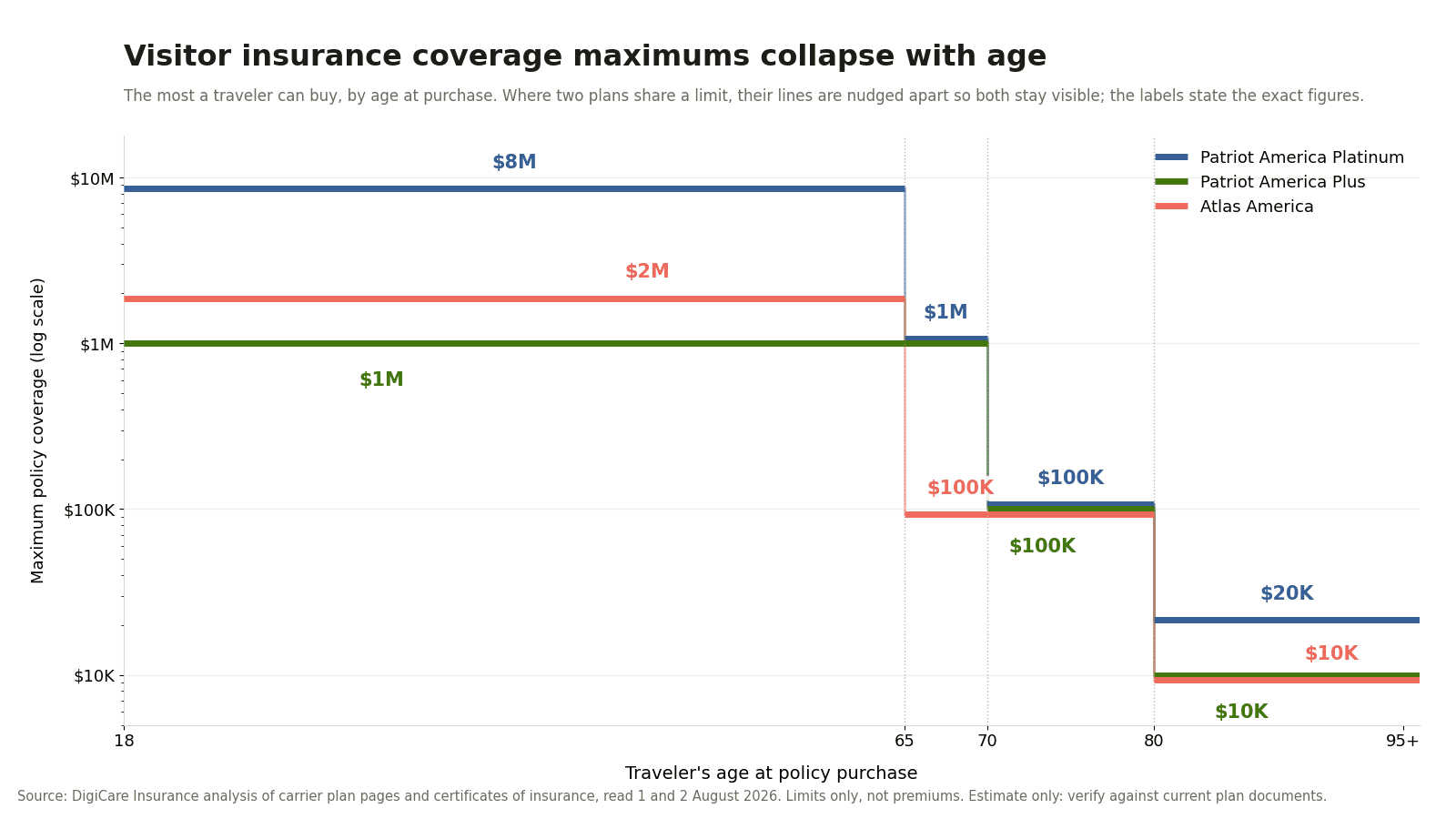
That table needs two warnings. Atlas America and Atlas America Premium publish their ceiling on two bases at once, an overall maximum limit and a maximum per injury or illness, and the age bands above are identical on both. Confirm the exact figure for your own age at the point of purchase. And "same" in the Trawick rows means the policy maximum itself is flat by age on those three plans. It does not mean age is irrelevant to them, as the next two sections show.
Atlas America runs two further age ladders that are easy to mistake for the medical one. Its description of coverage sets common carrier accidental death at $50,000 for ages 18 through 69, $25,000 for ages 70 through 74 and $12,500 from age 75. A separate accidental death and dismemberment benefit pays a lifetime maximum of $25,000 for ages 18 through 69, $12,500 for ages 70 through 74 and $6,250 from age 75. Both sit close to the medical limits in the same schedule of benefits, and neither is a medical maximum. We flag them because we misread one of them ourselves on the first pass, and because the age cliff turns out to run through all three benefits independently.
Key finding
The J-1 exchange visitor rule sets a federal floor of $100,000 per accident or illness. An 80-year-old buying Patriot America Plus can purchase a maximum of $10,000, one tenth of the floor the federal government considers adequate for a young exchange visitor. The J-1 rule does not apply to that 80-year-old, and nobody is breaking it. The point is what the market chooses to offer.
What this means: the median helicopter ambulance charge of $36,400 exceeds the entire policy maximum available at age 80 on four of the eight plans, and exceeds it on Patriot America Plus by more than three times. The people most likely to need an ambulance are sold the smallest ceilings. That is not a defect in any one plan. It is the shape of the whole market, and it is the single most useful fact on this page for anyone insuring a visiting parent.
Does visitor insurance cover pre-existing conditions after 70?
Sometimes, but "covers pre-existing conditions" means four different things across these plans. Atlas America pays up to the full policy maximum. Safe Travels USA pays an unexpected recurrence up to $1,000 and stops the benefit entirely at 70. The Patriot plans require the insured to be under 70. Seven Corners pays nothing from age 80.
Not one of the search results we reviewed puts those four positions side by side. Two plans can both advertise pre-existing condition coverage and differ by a factor of a thousand.
Nearly every plan here uses the term "acute onset of a pre-existing condition", which means a sudden, unexpected flare-up requiring immediate treatment. It is not the same as coverage for a condition you already know you have and expect to treat.
Acute onset of a pre-existing condition, by plan and age
| Plan | Age 69 and under | Age 70 to 79 | Age 80 and over |
|---|---|---|---|
| Atlas America | up to the overall maximum limit | up to the overall maximum limit | up to the overall maximum limit |
| Atlas America Premium | up to the overall maximum limit | up to the overall maximum limit | not covered (insured must be under 80) |
| Patriot America Plus | up to the Period of Coverage limit | not covered (insured must be under 70) | not covered |
| Patriot America Platinum | tiered, see prose above | not covered (insured must be under 70) | not covered |
| Safe Travels USA | $1,000 per period of insurance | benefit not available from age 70 | benefit not available |
| Safe Travels USA Comprehensive | full policy maximum selected | $35,000 at age 70 | $20,000 |
| Safe Travels USA Cost Saver | $1,000 per period of insurance | benefit not available from age 70 | benefit not available |
| Travel Medical USA Visitor Basic/Choice | up to $75,000 | up to $25,000 | no coverage |
Read the Atlas America row with care. We found no standalone age gate on its acute onset benefit, unlike IMG's clean "under 70" rule, so the benefit pays up to the overall maximum limit at every age. That maximum is itself age-banded, so an 80-year-old's acute onset coverage still stops at $10,000.
Patriot America Platinum splits the benefit four ways, by citizenship and by whether the insured holds a primary health plan. Its certificate caps US citizens aged 64 and under without a primary health plan at $20,000, US citizens aged 64 and under with a primary health plan at $1,000,000, US citizens aged 65 to 69 at $2,500, and non-US citizens aged 69 and under at $1,000,000. A US citizen aged 66 and a non-US citizen aged 66 are therefore offered $2,500 and $1,000,000 for the same benefit on the same plan.
The fine print then narrows things further. The evacuation portion of an acute onset claim is separately capped at $25,000 on Atlas America, Atlas America Premium, Patriot America Plus and Patriot America Platinum, which is well under the median helicopter charge. Atlas America Premium also requires treatment to begin within 24 hours of onset.
The Trawick plans add a second age split that has nothing to do with pre-existing conditions. All three Safe Travels plans cap cardiac conditions at $25,000 for insureds aged 69 and under, and $15,000 from age 70. A heart attack is the single most likely large claim in this age group, and it carries its own smaller ceiling on every Trawick plan.
The age-70 pattern is not confined to these eight plans. Other sellers publish a similar cliff, including one program that caps acute onset at a flat $30,000 for anyone aged 70 or over regardless of the policy maximum purchased.
What this means: for a visitor over 70, the policy maximum is often the wrong number to shop on. The acute onset cap and the cardiac sub-limit will decide most real claims at that age, and those two figures vary far more between plans than the headline maximum does. Read them before you read the ceiling.
Which deductible should you choose?
Pick the lowest deductible you can accept, then check the coinsurance underneath it. Deductible ladders in this set run from 6 to 9 rungs and from $0 to $25,000. A $0 deductible does not mean $0 out of pocket. Patriot America Plus still charges 10% coinsurance out of network, and Atlas America Premium adds a $200 emergency room copay in the US.
Deductible ladders, all 8 plans
| Plan | Rungs | Ladder |
|---|---|---|
| Patriot America Plus | 6 | $0, $100, $250, $500, $1,000, $2,500 |
| Atlas America | 7 | $0, $100, $250, $500, $1,000, $2,500, $5,000 |
| Atlas America Premium | 7 | $0, $100, $250, $500, $1,000, $2,500, $5,000 |
| Safe Travels USA | 8 | $0, $50, $100, $250, $500, $1,000, $2,500, $5,000 |
| Safe Travels USA Comprehensive | 8 | $0, $50, $100, $250, $500, $1,000, $2,500, $5,000 |
| Safe Travels USA Cost Saver | 8 | $0, $50, $100, $250, $500, $1,000, $2,500, $5,000 |
| Patriot America Platinum | 9 | $0, $100, $250, $500, $1,000, $2,500, $5,000, $10,000, $25,000 |
| Travel Medical USA Visitor Basic/Choice | range | $0 to $200, set by traveler age |
Three rungs are unique on this board. Trawick's $50 rung appears on all three Safe Travels plans and nowhere else, which matters because it is well below the $530 average emergency department visit, so choosing it barely dents that bill. Patriot America Platinum's $10,000 and $25,000 rungs appear nowhere else either, and a $25,000 deductible only makes sense against that plan's $8,000,000 ceiling.
Coinsurance is the part buyers skip. IMG's own certificate of insurance for Patriot America Plus sets it out as a three-way table:
Coinsurance (In addition to Deductible): United States In-Network, Plan pays 100% / Insured pays 0%; United States Out-of-Network, Plan pays 90% / Insured pays 10%; International, Plan pays 100% / Insured pays 0%. Out of Pocket Maximum: $0 / $500 / $0.
Patriot America Platinum's certificate is flatter: the plan pays 100%, the insured pays 0%, and the out-of-pocket maximum is $0, with no separate network split. Atlas America's page states that the plan pays 100% of eligible expenses after the deductible, though the wording we captured was truncated and we cannot confirm the full percentage table. On Atlas America Premium there is no complete coinsurance table on the plan page, though it does disclose a $200 emergency room copay for illness claims incurred in the US. The three Safe Travels plans and the Seven Corners plan did not publish a coinsurance table on the pages we read.
What this means: on Patriot America Plus, a $0 deductible plus an out-of-network hospital still costs the insured 10% up to a $500 out-of-pocket maximum. On Atlas America Premium, a $0 deductible still costs $200 for an emergency room visit for illness. The deductible is a floor on your spending, never a cap.
Evacuation, repatriation and the sub-limits nobody compares
Sub-limits are where two plans with identical policy maximums stop being identical. The table below is the full set we could confirm from carrier documents.
| Plan | Emergency medical evacuation | Repatriation of remains | AD&D principal sum | Trip interruption | Lost luggage | Dental |
|---|---|---|---|---|---|---|
| Atlas America | $1,000,000 lifetime | not confirmed | not confirmed | $10,000, no deductible | not confirmed | not confirmed |
| Atlas America Premium | $1,000,000 lifetime | equal to elected maximum | $5,000 to $100,000 by age | $15,000 | $2,000 | $300 |
| Patriot America Plus | $1,000,000 | equal to Period of Coverage limit, plus $5,000 local burial | $50,000 | none, confirmed absent | $500, $50 per item | $300 |
| Patriot America Platinum | equal to Period of Coverage limit | equal to Period of Coverage limit, plus $5,000 local burial | $50,000 | not confirmed | $500, $50 per item | $300 |
| Safe Travels USA | $1,000,000 | $50,000 | $25,000 | $5,000 | $1,000 | $250 |
| Safe Travels USA Comprehensive | $1,000,000 | $50,000, plus $15,000 medically necessary repatriation | $25,000 | $5,000 | $1,000 | $250 |
| Safe Travels USA Cost Saver | $1,000,000 | $50,000 | $25,000 | $5,000 | not found | $250 |
| Travel Medical USA Visitor Basic/Choice | $100,000 | $25,000 combined | not stated | not stated | not stated | $750 |
Four things in that grid deserve calling out on their own. Patriot America Plus carries no trip interruption benefit at all. We confirmed this against the full table of contents of IMG's own certificate of insurance, sections A through EE, rather than inferring it from an omission on a marketing page. Every other plan in this set that publishes the benefit does offer it, from $5,000 on the Trawick plans to $15,000 on Atlas America Premium. We report the absence as a finding, not as a gap in our reading.
Seven Corners caps emergency medical evacuation at $100,000. The other seven plans publish $1,000,000 or a figure that scales with the policy maximum. Set against the $40,600 median fixed-wing air ambulance charge, a $100,000 evacuation limit covers roughly two transports and nothing else.
Inside IMG's own program the two Patriot plans pull apart. Platinum ties evacuation to the Period of Coverage limit rather than capping it flat, so a buyer at the $8,000,000 rung carries an $8,000,000 evacuation ceiling. Plus caps it at a flat $1,000,000 no matter which maximum is purchased. Platinum also carries a benefit Plus does not: non-emergency medical evacuation up to $50,000, restricted to insureds under 65.
Dental runs the other way. Seven Corners pays $750 against $250 to $300 everywhere else, and it publishes an incidental trips to home country benefit of up to $50,000 that no other plan in this set names.
What this means: the sub-limits move independently of the policy maximum, and they move in both directions. The plan with the highest ceiling in this index has no confirmed trip interruption benefit and the lowest ceiling comes with the highest dental limit. Compare the benefit you expect to use, not the headline number.
Is any of this legally required?
For most visitors, no. The one nonimmigrant category with a federal insurance minimum is the J-1 exchange visitor, under 22 CFR 62.14. That rule sets a floor of $100,000 per accident or illness, $25,000 for repatriation of remains, $50,000 for medical evacuation to the home country, and a deductible ceiling of $500 per accident or illness.
The J-1 minimums are worth reading in full, because they are the only published federal benchmark for what adequate visitor coverage looks like. The current text of 22 CFR 62.14 requires:
| Requirement | Federal minimum |
|---|---|
| Medical benefits | at least $100,000 per accident or illness |
| Repatriation of remains | $25,000 |
| Medical evacuation to the home country | $50,000 |
| Deductible ceiling | not to exceed $500 per accident or illness |
| Coinsurance ceiling | may require the exchange visitor to pay up to 25% of covered benefits |
Source: 22 CFR 62.14 (eCFR)
The same rule sets a carrier-quality floor that almost no consumer page mentions. A qualifying policy must be underwritten by an insurer rated A.M. Best A- or above (or S&P A-, Fitch A-, Moody's A3, Weiss B+), or be backed by the exchange visitor's home government, or be a designated sponsor's group plan, or run through a federally qualified HMO. The rule also permits a pre-existing condition waiting period that is "reasonable as determined by current industry standards", which is the federal government's own acknowledgement that this exclusion is normal. Exchange visitors who willfully fail to maintain the coverage face termination from the program.
Date the rule correctly if you cite it. The current text dates from a 2014 rulemaking published at 79 FR 60307 on 6 October 2014.
One requirement that used to exist is gone. Proclamation 9945 of 4 October 2019 would have required immigrant visa applicants to show approved health coverage. It was revoked effective 19 May 2021, at 86 FR 27015, on the finding that the suspension of entry it imposed "does not advance the interests of the United States". Advice pages still repeat it. It is not law.
Source: Federal Register, revocation of Proclamation 9945
At the state level, the NAIC adopted its Travel Insurance Model Act in December 2018, and reports that as of April 2026, 38 states have enacted it. The same NAIC page carries a warning worth repeating: travel products are often bundled, and "only the insurance products have the oversight of state insurance departments". Cancellation fee waivers and travel assistance services sit outside your state insurance department's authority.
For the B-2 tourist case specifically, see our answer page on whether visitor insurance is required for a B-2 visa.
What this means: no federal rule stops a carrier from selling an 80-year-old a $10,000 ceiling, because the only federal minimum in this area applies to J-1 exchange visitors, who skew young. The $100,000 J-1 floor is the closest thing to an official opinion on adequate coverage, and every 80-and-over rung in this index falls below it. Visitors who plan to seek health coverage after a status change should start with our health insurance guidance instead, since eligibility there turns on residency rather than visa type.
Methodology and limits of this dataset
Every figure in this index comes from a carrier's own plan page or certificate of insurance, fetched on 1 and 2 August 2026 with the HTTP status and a content hash recorded for each fetch. Where a figure came from a certificate of insurance, we name the form number: Patriot America Plus is form PATAP (PGTAP) 04.29.26, Patriot America Platinum is form PPLAI (PPLGA) 04.29.26, and Atlas America's age bands and its two accidental-death ladders come from the Atlas Travel Description of Coverage, form 1001150625. Cost-of-care anchors come from federal sources only, cited inline above with their data years.
Every dollar figure on this page is a limit, not a premium. A limit is the most a plan will pay. A premium is what the plan costs. We publish no premiums, and the reason is a finding in itself: visitor plan premiums exist only behind quote engines, and the two marketplace engines that hold most of them are closed to crawlers. No premium figure could be independently verified, so none appears. Any figure you see elsewhere describing what these plans cost is a seller quoting its own book.
We are naming four gaps rather than papering over them. INF Elite is missing from this index because infplans.com returned HTTP 403 on every path we attempted. Secondary sources publish figures for it. None is verified against the carrier's own document, so we published none.
CoverAmerica-Gold is excluded from the matrix because its own brochure and rates pages route to a marketplace we do not cite. Its age-70 acute onset figure appears in prose above as corroboration of a pattern, without a matrix row.
Several cells read "not confirmed" or "not found". Those mean we did not verify the figure, not that the benefit is absent. The one confirmed absence in this index is Patriot America Plus trip interruption, which we checked against the certificate's full table of contents. We did not transfer that finding to Patriot America Platinum, whose table of contents we did not review in full. The underwriter column is deliberately incomplete: where no certificate or carrier page named a risk-bearing company, we wrote nothing.
Our sourcing and review standards are set out on our how we review page. This article is published by DigiCare Insurance as an organization. DigiCare is not a licensed insurance agency, and this index is information, not advice. See our affiliate disclosure for how we are paid.
Timeline
The regulatory and master-policy dates behind this data
October 6, 2014
Current J-1 insurance rule text published (79 FR 60307)
December 2018
NAIC adopts the Travel Insurance Model Act
May 19, 2021
Proclamation 9945 revoked (86 FR 27015)
September 10, 2021
HHS ASPE publishes its air ambulance issue brief
October 1, 2025
Patriot America Plus Master Policy takes effect
April 29, 2026
Patriot America Platinum Master Policy takes effect
Takeaways
The seven findings worth remembering
- 1
Patriot America Platinum drops from up to $8,000,000 to $20,000 at age 80. That is a 400-fold reduction in the ceiling, on the same plan, from the same underwriter.
- 2
Four of the eight plans cap an 80-year-old below the median helicopter ambulance charge of $36,400. Patriot America Plus tops out at $10,000 for that traveler.
- 3
The federal J-1 minimum is $100,000 per accident or illness. Every 80-and-over rung in this index is below it, and most are far below it.
- 4
"Covers pre-existing conditions" means four different things here, from the full policy maximum on Atlas America down to $1,000 on Safe Travels USA, which withdraws the benefit entirely at 70.
- 5
Patriot America Plus carries no trip interruption benefit, confirmed against the full table of contents of its own certificate of insurance.
- 6
Deductible ladders run 6 to 9 rungs, from $0 to $25,000. Trawick's $50 rung and Platinum's $10,000 and $25,000 rungs exist on no other plan in this set.
- 7
A $0 deductible is not $0 out of pocket. Patriot America Plus charges 10% coinsurance out of network up to a $500 out-of-pocket maximum, and Atlas America Premium adds a $200 emergency room copay in the US.
FAQ
Frequently asked questions
Is a $50,000 policy maximum enough for visitor insurance?+
It is thin against published US costs. HealthCare.gov puts an average three-day hospital stay at around $30,000, and the median helicopter ambulance charge in 2017 data was $36,400. Either event alone consumes most of a $50,000 ceiling. For travelers under 70, higher rungs are available on every plan in this index.
What is the most coverage an 80-year-old visitor can buy?+
Among the eight plans here, $20,000. That is the ceiling on both Patriot America Platinum and Atlas America Premium at 80 and over. Patriot America Plus and Atlas America cap at $10,000. The three Safe Travels plans do not age-band the policy maximum itself, though they do reduce cardiac and pre-existing benefits from 70.
Does a higher policy maximum mean more pre-existing condition coverage?+
Not reliably. On Atlas America and Safe Travels USA Comprehensive the acute onset benefit tracks the policy maximum you select. On Safe Travels USA it is a flat $1,000 regardless of the maximum. On Patriot America Platinum a US citizen aged 65 to 69 is capped at $2,500 even at the $8,000,000 rung.
Which plan offers the lowest deductible option?+
Every plan in this index includes a $0 deductible option. On seven of the eight, it is a discrete rung; on the Seven Corners plan, it is the bottom of an age-set range rather than a standalone choice. The three Safe Travels plans from Trawick International are the only ones offering a $50 rung, well below the $530 average emergency department visit cost reported in 2017 federal data.
Which of these plans include trip interruption?+
Atlas America pays up to $10,000 and is not subject to the deductible. Atlas America Premium pays up to $15,000. All three Safe Travels plans pay up to $5,000. Patriot America Plus carries no trip interruption benefit at all. We could not confirm the position for Patriot America Platinum or the Seven Corners plan.
Is visitor insurance required to enter the United States?+
The one nonimmigrant category with a federal insurance minimum is the J-1 exchange visitor, under 22 CFR 62.14. Proclamation 9945, which would have required immigrant visa applicants to show health coverage, was revoked effective 19 May 2021 at 86 FR 27015.
Related reading
Next questions people ask
- Is visitor insurance required for a B-2 visa?
- Visitor insurance for parents visiting the USA
- Health insurance when no employer covers you
This index sits under Visitor insurance, where the plan reviews and comparisons live.
Compare what visitor plans actually pay at every age, before you buy.
Every figure above comes from a carrier's own certificate of insurance, not a marketing page. Start with the visitor insurance hub for how comprehensive and fixed-benefit plans differ, what every plan excludes, and where the plan reviews and comparisons publish next.
- Independent: we don't sell insurance
- No forms, no sales calls
- Sourced from NAIC & state DOIs